

Understanding dog body language is crucial for developing trust and maintaining optimal communication with your pet. Dogs primarily use body language to communicate, and if you are able to read their signals, you will find it easier to understand their feelings and behavioral patterns. Misreading these signals may invite misunderstanding, making it difficult for you to meet your dog's needs or, worse, get into dangerous situations.
This article will cover key signs that happen in commonplace situations, some of the misunderstandings that this may cause, and practical guidance in regard to how to decode your dog's body language.
Understanding Dog Body Language
Just like humans do, dogs communicate their emotions and intentions through body language. With these signals effectively decoded, you will be in a better position to assess a dog's emotional state and the motivation behind its actions. Here are the key components to keep note of.
Dog Body Language Chart
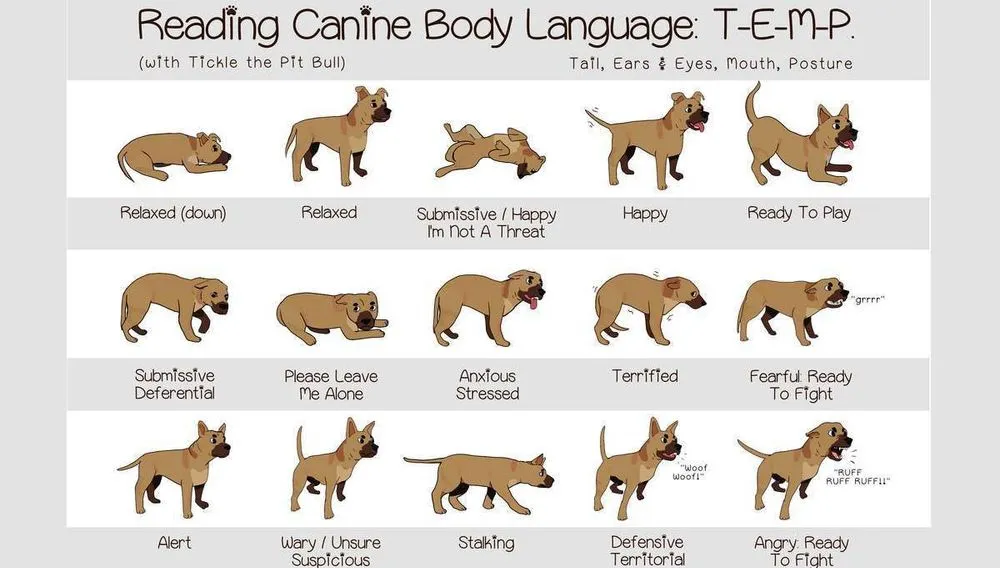
Tail Movements
Their tail is referred to as a marker and it is one of the most evident and common ways a dog communicates with others of its species and humans. Very subtle changes in the position and movement of a dog’s tail indicates different things. Mentioned below are some tail movements that you would have been able to observe and what exactly they mean.
- Wagging Tail: A wagging tail leads to differing emotional states like happiness and excitement, when it is done fast, or uncertainty and stress, when slow. According to the investigations, a dog wags to the right when happy and fears it remains to the left.
- Tail Tucked: When a dog tucks its tail between the legs, then it signifies fear or submission. This behavior shows that the dog is feeling threatened or anxious,
-
Straight Tail: An upright tail indicates the alert, confident
mood of a dog. The higher a dog’s tail is, the more alert they
are. A dog with an upright, well-elevated tail frequently stands
ready to interact with the world or another dog. A dig that is
relaxed will have its tail in a neutral position, depending on
its breed.
Ears and Eyes
- Ears Upright & Forward: Perked ears mean curiosity or attentiveness. Dogs often perk their ears when they hear something interesting or are focused on something. As for breeds that have floppy ears, the base of their ear would be perked forward.
- Drooping Ears: Droopy might mean relaxed, or, in another way, submissive. In that posture, the ears indicate that the dog is feeling insecure or submissive in the prevailing situation.
-
Wide open eyes: Wide open eyes or sometimes referred to as whale
eyes may indicate excitement or anxiety. Blinking softly may
indicate that the opponent is not a threat, while squinting may
mean that the opponent is somewhat out of place to deal.
Mouth and Sounds
Among the host of ways dogs communicate is through their mouth and through sounds.
- Open mouth: Generally, a relaxed dog will have a slightly open mouth with a tongue hanging down, a sure sign of comfort and happiness. On the other hand, a tight closed mouth can denote tension or fear.
- Tongue: The position of their tongues also indicate a lot of different things. If they have their tongue hanging flat down, it usually means they feel safe and happy. While if the end/tip of their tongue curves upwards, this indicates they are stressed. A loose side hanging tongue denotes that they are tired.
-
Snarling and barking: Snarling generally indicates aggression or
fear; that is, the dog considers itself in a threatened position
and warns all others to keep away. Also,
different tones of barking deliver different messages:
high-pitched means excitement or playfulness, while
low-pitched is for warnings or aggression.
Body Postures
Their body posture is another clear communicator as to what they are feeling and trying to communicate. Here are a few common body languages:
- Play Bow: This posture arises when dogs bend their front legs but keep their back end raised; it signifies a message to play. This is undoubtedly one of the signals that a dog means no harm and wants to have fun.
- Stiff Stand: The stiff body stance, together with the hackles raised, means aggressiveness or fear. In this case, the dog feels threatened and is preparing itself for defense if necessary.
- Roll over: When a dog rolls over and shows its belly, this may be a sign of submission and trust, but could also mean the dog is looking for affection.
How to Understand Dog Language?
To understand dog language means to interpret their emotions and intentions based on cues and signals in combination. This means you shouldn't just concentrate on one behavior in isolation; you must concentrate on the context as a whole and look for clusters of signals. If a dog yawns while playing, it more likely indicates stress than boredom. If a dog yawns after waking up, that's completely normal.
Recognizing Signals
The most important factor is recognizing signals in various
situations. A relaxed, excited dog wags his tail and often appears
to smile, with the eyes soft and the mouth relaxed. Picture a dog
greeting its owner at the door, tail wagging and body doing a happy
wiggle.
Conversely, a stressed or anxious dog may show subtle signs like
yawning (when not tired), licking his lips, pacing about the room,
or tucking his tail between his legs. Think about a dog at the vet's
office standing and shifting weight apprehensively, nervously
licking his lips. An aggressive dog will exhibit stronger signals,
showing the bared teeth, the stiff body posture, direct staring, and
raised hackles ('the hair on the back standing up').
Picture two dogs squaring off against each other with stiff bodies
and raised hackles, indicating a clear threat of an impending
conflict. A fearful dog tends to avoid eye contact and may tremble,
crouch, or try to hide. Think of a dog cowers into a corner in a
thunderstorm.
Sometimes, specific activities also have certain associated
behaviors. A dog falling asleep keeps a relaxed body posture, some
twitching moments taking place in sleep for the dreaming process of
what has happened over the day.
Typically, when dogs start playing, it begins with a "play bow"
where they exhibit a lowered front end with a raised rear end while
wagging their tails and letting out playful yaps. Think of two
puppies biting each other's faces and play-wrestling with each
other.
Understanding these scenario-based signals will greatly enhance communication with and strengthen the bond you have with your canine friend. Other behaviors include circling before lying down (an instinctual behavior for flattening grass), or digging (which can relate to burying food or establishing a cool resting place).
Common Misinterpretations and Their Dangers
Misunderstood Signals
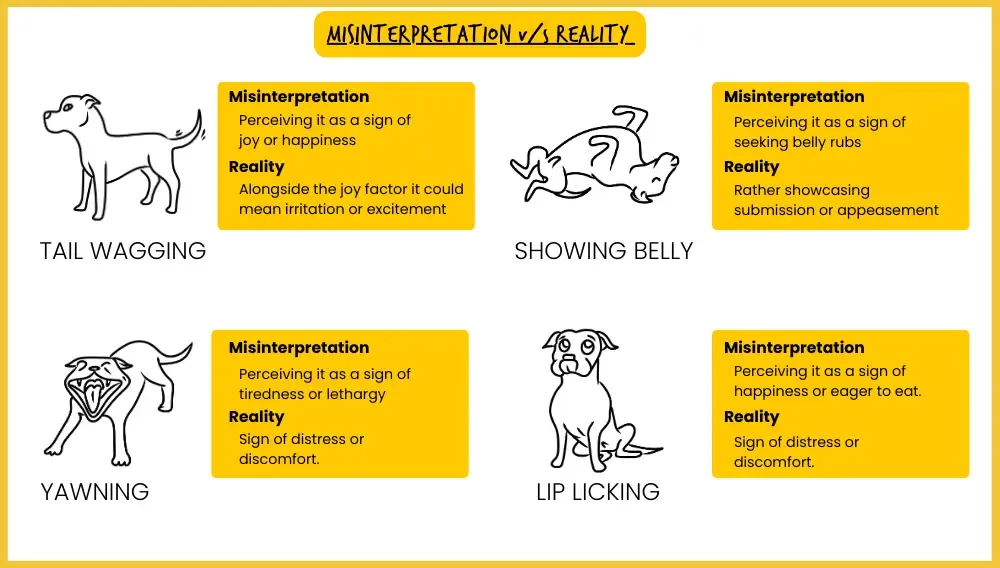
One of the most common misinterpretations pertains to tail wagging.
While a good, loose and wide wag probably means joy, a stiff, high,
or more shorter wag may indicate excitement or irritation. It's best
to analyze the dog's entire body posture instead of just focusing on
the tail.
Another common sign is when a dog shows its belly. While some dogs
welcome belly rubs, a dog rolling over onto its back can actually be
in submission or appeasement, indicating that the dog is trying to
de-escalate a perceived threat. A dog in this position is vulnerable
and approaching them could make you seem like more of a threat.
Some other misinterpreted signals are yawning. Yawning doesn't
always indicate that they are tired. It could also indicate stress
or discomfort in certain situations. This is called stress yawning.
It could also be a coping mechanism of a dog to deal with a past or
present stressful situation.
Some others are lip licking, indicating anxiety and standing still, which could be an indication of perceived threat.
Risks
Dogs bank on body language to communicate with each other and with
us. Misinterpreting this could have dire risks.
When a dog is stressed they give subtle stress signals like yawning,
lip licking etc. When their boundaries are crossed and their
signals are ignored, the dog could feel threatened, irritated and
may get defensive. This could lead to aggressive reactions from the
dog leading to dog bite cases.In most instances, to approach a dog
who exhibits fear or stress puts that particular dog at a very high
risk for a bite incident.
Such an incident could lead to damage in the dog-human bond. This could have short or long term effects in terms of trust and communication between both parties. It would take a lot of time, patience, and practice to regain the lost trust.
Tips
To prevent such situations, it is important to understand your dog’s
body language.
Always analyze the whole body; put together the tail, ears, eyes,
mouth, and posture in a context-sensitive fashion. By keeping an eye
on the complete picture helps understand their state better.
Apart from this, it is crucial to know the context in which the dog
is. A dog is likely to be more cautious and show fear in a situation
or environment it is new to as compared to them in the safe space of
their home.
When a dog shows any or all of the above signs of stress, it is
important to read it correctly and respect their boundaries. Avoid
fast or sudden movements from your end. Never force yourself toward
the dog in such a case, if the dog is comfortable they will come to
you.
Remember, each dog is different and special in their own ways. Take
the time and effort to learn your dog’s boundaries and their way of
communicating things. It is important to keep your dog and yourself
safe at all times.
Practical Tips for Observing Dog Body Language
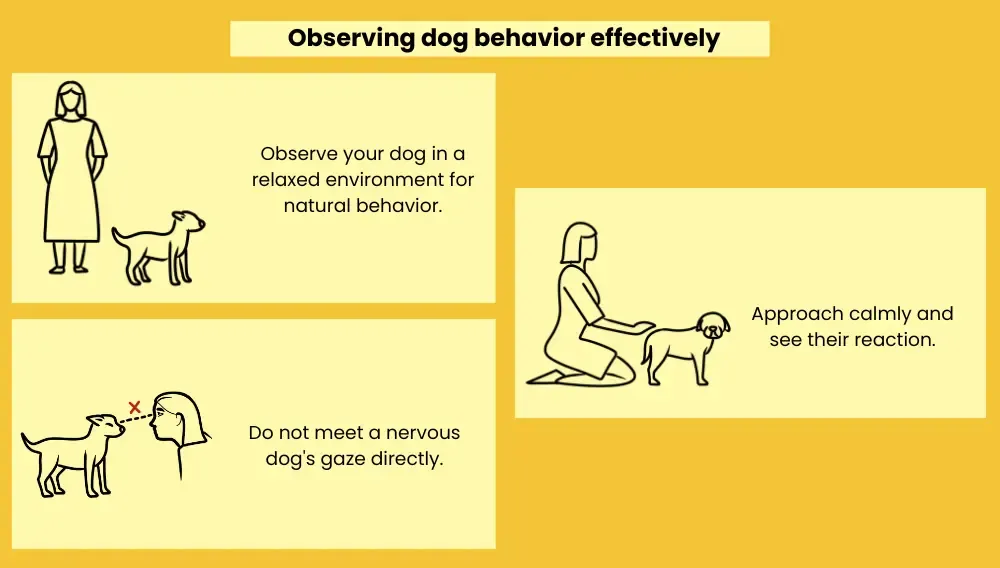
Monitoring dog body language effectively requires patience and a
mindful approach. Start observing dogs in a calm and familiar
environment, such as their home or a quiet park, to see their
natural behaviors without external stressors.
When interacting with a dog - especially one who might seem fearful
or unsure - avoid direct eye contact, since this might be
misconstrued as an invitation for a challenge or perceived as a
threat.
Approach calmly, from the side, enabling the dog to approach you if he/she wishes. Pay attention to their reactions: is he/she relaxed, curious, or showing signs of stress? Observing the rest of the dog, from the tip of their tail to the position of their ears is also essential for a proper reading.
How Physically Challenged Owners Can Interpret Dog Body Language
Visually Impaired Owners
For the visually impaired, tactile signs or vocalizations are the
way to go. The tension in a dog's muscle, the position of its tail
underneath or slightly to the side of a leg, or the direction in
which it directs its head will send numerous signs.
For example, tension in the shoulder muscles could indicate stress, while a tucked tail suggests fear. Particular emphasis is more on such vocalizations as whimpering, growling, or barking when understanding a dog's emotions.
Hearing Impaired Owners
When it comes to the hearing-impaired, they rely more on visual signals. In such cases, focusing on body position, tail movement, facial expression position, and ear position is the way to go. A stiff body and raised hackles indicate aggression, whereas a relaxed body and wagging tail reflect happiness.
Tools
Several devices and training techniques could assist physically
challenged owners. Training assistance dogs usually includes some
form of tactile cues denoting situations or signs, e.g., nudging a
hand or leaning against a leg.
Tactile communication methods also include manipulating different
pressures or textures on a dog's body. Each touch could have a
different meaning and can effectively communicate commands.
For example, a light tap on the shoulder might mean, "sit," and a
light stroke down the back might mean, "stay."
With these tools and methods, the physically challenged owners can effectively communicate with their dogs and can build a solid and mutually enriching bond.
Got More Questions about Your Dog’s Signs & Gestures?
Trust building and dog safety start with an understanding of canine
body language. To approach any complicated behavioral issue, talking
to a vet or trainer can prove incredibly valuable.
The sploot app connects you with other pet parents who can share
their experiences, which often contain expert advice. For more
information, events, or to ask our experts
questions, connect with sploot on
Instagram
or join us for AMA sessions and Pup Talks.
FAQs on Dog Body Language
What does a wagging tail mean in dog body language?
It can indicate happiness, but also stress or excitement depending on the context.
How can I identify stressed dog body language?
Look for signs like lip licking, yawning, and pacing, often accompanied by a tucked tail.
How can I understand dog language to build a stronger bond with my pet?
Pay attention to your dog’s body cues and respond calmly to their needs.
How do dogs show feelings?
Dogs show feelings through their body language, such as tail movement, ear position, and facial expressions.
What does dog body language convey when a dog is uncomfortable?
A dog may show discomfort through lip licking, avoiding eye contact, or retreating from the situation.
How to read dog body language?
Observe the tail, ears, posture, and facial expressions to understand their mood.
Why is it important to learn how to understand dog body language?
It helps ensure you respond appropriately to your dog’s emotional
needs, improving their well-being and your bond.